Thursday, September 15, 2011

Latino Heritage Month, September 15-October 15

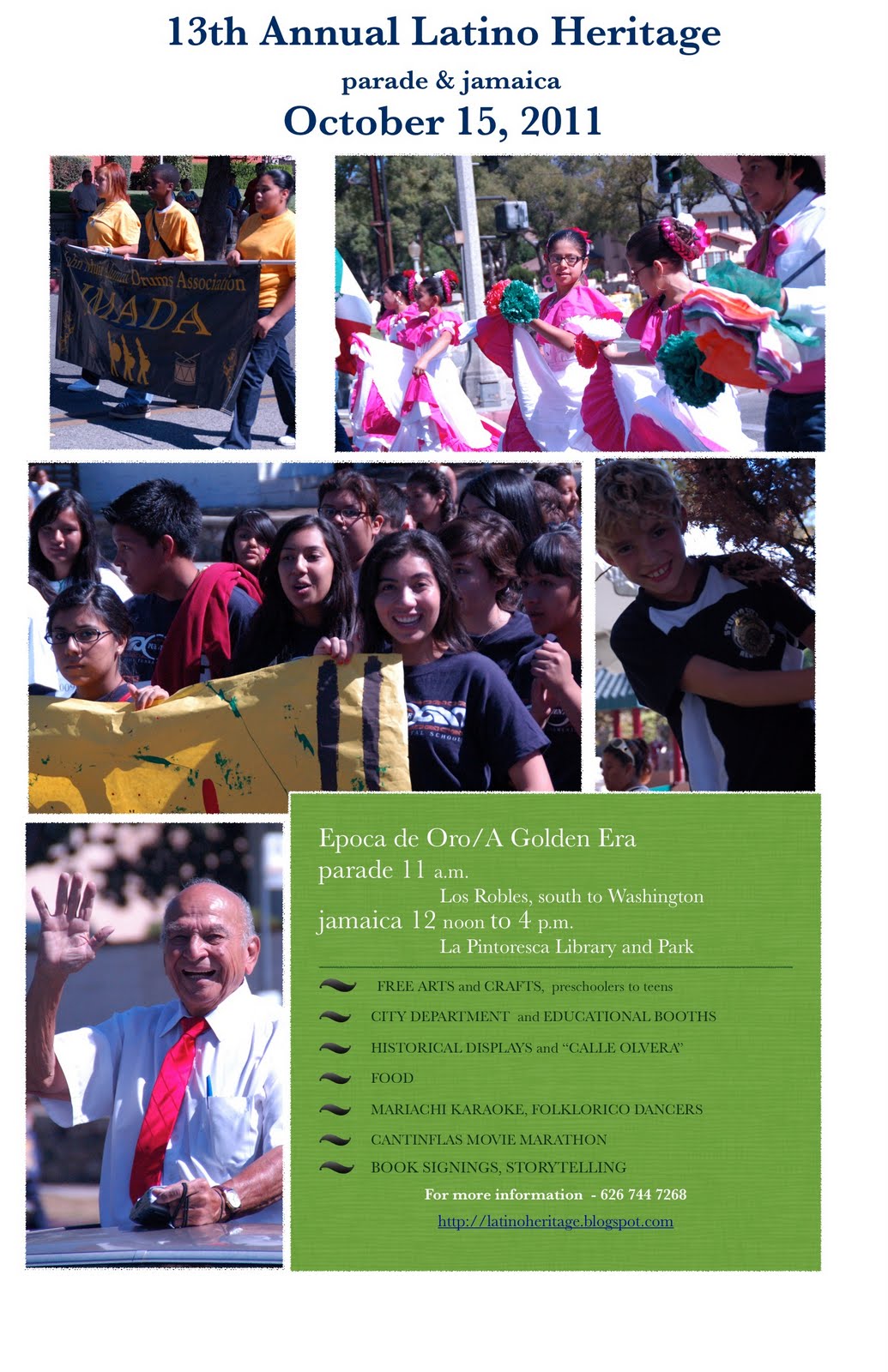
Here's our poster for this year's event.

Things are developing at a fine clip. The meeting with the various City of Pasadena departments went off smoothly thanks in part to each of the department's representative and especially thanks to Michelle Bernal of as well the partnership that is becoming stronger with the Human Services and Recreation Department and Rozanne Adanto, Villa Parke Community Center Supervisor.

Revisions will undoubtably take place in the next month - that's sort of the nature of the event beast.

I read a quote today that seems both appropriate for the beginning of Latino Heritage Month and for our preparations for parade & jamaica. It is a quote from "Life in the Time of Cholera" by Garcia Marquez.

"Human beings are not born once and for all on the day their mothers give birth to them, but [rather] life obliges them over and over again to give birth to themselves".

How we define ourselves, by our our roots and by our experiences, is a constantly evolving thing.

Turns out this even holds true for parades.


Tuesday, September 13, 2011

Celebrating a Culture of Hope and Progress


Announcing a poster competition for Latino Heritage Month - in Los Angeles.

However, this contest is open to all students grades K-12 in Los Angeles County. The details are in the flyer.

Thanks to the sponsors and to Los Angeles Cultural Affairs - especially Rebeca Guerrero for hosting this most meaningful contest.

Winners will receive Blick Premium Art Supplies.

The deadline is this Friday, September 16, 2011 by 6:00 p.m.


Sunday, September 11, 2011

Gilbert "Magu" Luján

Artist Gilbert "Magu" Luján's memorial took place today at Belvedere Park, East Los Angeles Civic Center. It was a beautiful day with soft, solid gusts of wind rustling the papel picado that helped to change a blank white wall to a wonderful homage to Magulandia.
The ofrenda overflowed with photos of Magu and loved ones, as well as icons and symbols
of the things that were special to him.

Ave Maria, Los Cuatro Direciones, danzantes, Nahuatl, oral history, and a duck that softly quacked as if on cue, were all a part of the ceremony.
Like Magu the ceremony was creative, complex, colorful.
Lucky we were here with you. Rest in Peace.

Con safos.

El Paseo y El Pasado

In 1781, a mere 10 years after Mision San Gabriel was established, 44 pobladores (townspeople), men, women, and children, arrived at Yangna, an area where the Tongva had lived for generations and generations. Over the next 150 years the descendants of the pobladores and the Tongva saw vast changes in what became known as the city of Los Angeles.

The area, like all of the land in the Southwest, was governed in turn by Spain, Mexico, and the United States. The Avila Adobe, home to Francisco and Encarnacion Avila, is purported to be the oldest house in the City of Los Angeles. Over time the center of the commerce and government moved and the area became dilapidated.

In 1928 as a response to the condemnation note on the Avila Adobe, Christine Sterling and others tirelessly worked to renovate and recreate their interpretation of a Mexican Bazaar. El Paseo de Los Angeles, later known as Olvera Street, was part tourist attraction, part romantic fantasy, and just a bit of genuine Mexican traditions.

http://www.image-archeology.com/Olvera_Street_Los_Angles_CA_009.jpg

For those whose parents and grandparents had come from Mexico, it was a place where you could see the jarabe tapatio, buy maracas, or eat taquitos. It was a place where spoken Spanish was permitted and where you could be proud to be a Mexican American.

It still serves that role - a little bit of fantasy, a little bit of commerce, and place worth noting in our regional history.
We'll have an homage to the Olvera Street at the jamaica.

Saturday, September 10, 2011

Fiestas Patrias in Pasadena

In this most difficult time it may be hard to understand a celebration like the Fiestas Patrias, so let me offer my perspective.

Latino Heritage Month is in part defined by the month in which 18 Latin American countries gained their independence.

It is part homage to homeland and to customs that are part of a childhood or a lifetime spent in another country. It is also a way for adults to share with children and youth what it was like to grow up in another country, perhaps in an era filled with turbulence and war. Or a place that was beautifully bucolic.

It is also a time to include history that has all too often been excluded in the classes and lesson plans that are a part of most student's lives.

The meaning of Fiestas Patrias will vary from community to community, from family to family, and from person to person. For most it is not about a desire to go back to where they came from so much as a desire to hold on to the traditions or memories that are precious, to use the Scottish phrase, to kith and kin. You know, your friends and family.
A celebration of the Fiestas Patrias will take place @ Villa Parke on Saturday, September 10, from 11 a.m. until 5 p.m.

Drop by, share some dance, share some music and dance, share some cultura,
share some time with your neighbors.

For details on the event -
http://cityofpasadena.net/EkContent.aspx?theme=Navy&id=6442460396&bid=2970&style=news

Friday, September 9, 2011

Yvonne Chavez Lombardi, 2011 Doña Eulalia Award Recipient

Yesterday I wrote about Doña Eulalia, her connection with Pasadena, and her dedication to her work.

As the parade & jamaica became an annual event, we found we wanted to acknowledge individuals who have dedicated themselves to the work it takes to coordinate and produce an event that has no paid staff. Any of you who have worked on similar projects know what I'm talking about. Raising money, permits, sharing the word, arriving at the park@ 6 a.m. before the lights have gone out on the streets and long before the warmth of the morning graces your back.

And so the Doña Eulalia Award was imagined. Raul Rodriguez, brilliant artist and designer of countless award winning Tournament of Rose floats, was our first recipient. Kevin Bruce, Abelardo de la Peña, Lilia Hernandez, and now Yvonne have received this recognition.
Yvonne's connection began our first year. She worked for the LightbringerProject: the folks who coordinate the Doo Dah Parade. In short time, she became involved with the parade & jamaica and has always been involved, save the years she was out of state.

Yvonne has shared her expertise freely and generously. Whether it was working on the printed program, getting a discount via a friend who gave her in-kind support for the event, coordinating stage of the participants, wearing a costume to help set the atmosphere of the event, or crawling under the stage to help dismantling it, or leading a workshop. If it needed to be done and she wasn't doing something doing something else - there she was ready to tackle it.
Yvonne is currently working at kidspace Children's Museum as the Director of Education and Community Initiatives.

Thursday, September 8, 2011

Eulalia Pérez de Guillen de Mariné

Cecilia Rasmussen is responsible for my first learning about Doña Eulalia some 13 years ago. Her LA Times "Then and Now" column was a very brief, but fascinating look at the centegenerian for whom Rancho el Rincon de San Pascual was reserved.

You can read her oral history, articles about her in places like Wikipedia, and many snippets in local early historians like J.W. Wood or Hiram Reid. Her son-in-law Miguel Blanco/Michael White devotes a chapter to her in his oral history.

According to family lore she was literate. Beyond this was a confidence that is apparent in her oral history and seems reflected in the lives of the women who were a part of her circle.

It is a profoundly proud woman who begins her oral history, "I, Eulalia Pérez..." It is a woman who was familiar to those who spoke English and those who spoke Spanish. In part because of her age and in part due to her amazing life, and her dedication to her work.

Eulalia Pérez de Guillén de Mariné died on June 8, 1878 four years after members of the Orange Grove Association moved to the land that had been known as Rancho El Rincon de San Pascual and eight years before much of the rancho was incorporated as the City of Pasadena.

Rasmussen - http://articles.latimes.com/1998/sep/06/local/me-20088
http://en.wikipedia.org/wiki/Eulalia_Pérez_de_Guillén_Mariné